
Adaptive HIIT: Interval Training for People with Disabilities
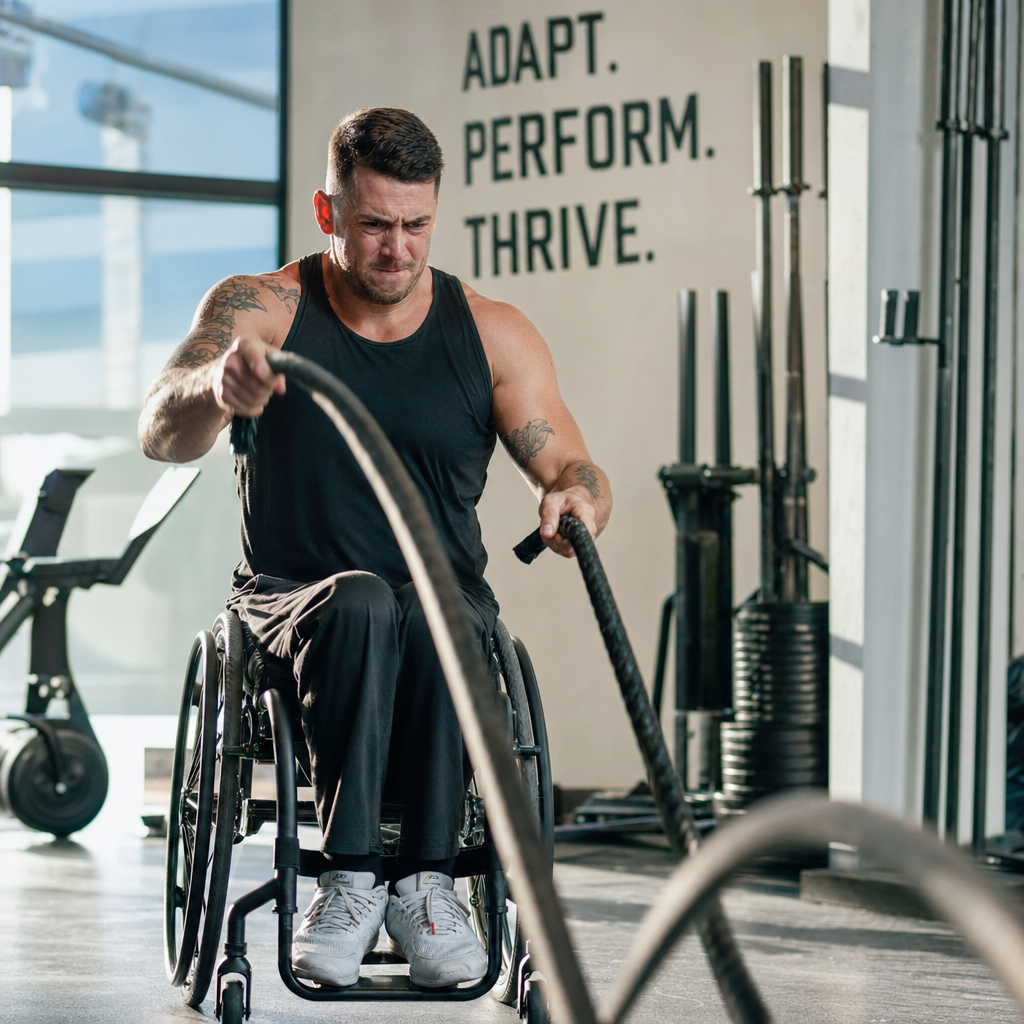
The most fundamental principle of HIIT is also the most flexible: alternating periods of high effort with periods of recovery. That principle doesn't require any specific movement, any specific equipment, or any specific body type. It just requires that you be able to push your effort to a high intensity for short periods, then recover, then repeat. For people with disabilities, the application of HIIT may look different from what you see in mainstream fitness media, but the underlying physiology — the cardiovascular adaptations, the metabolic improvements, the strength gains, the mood benefits — are exactly the same as for any other athlete.
The adaptive fitness world has expanded enormously in the last decade, and what's possible for athletes with disabilities now far exceeds what most able-bodied people imagine. Wheelchair athletes are completing CrossFit competitions, amputee runners are setting performance records, athletes with cerebral palsy are competing internationally, and people with chronic conditions are using interval training to manage their health in ways that medication alone can't. This post walks through how the principles of HIIT translate across different bodies and conditions, the adaptations that work, and the resources that can support your practice.
A note before going further: this post is written for adaptive athletes themselves and for the people who train with or coach them, but it's not a substitute for individualized guidance from healthcare providers and qualified adaptive fitness professionals. The diversity of disabilities and conditions is enormous, and what's safe and beneficial for one person may be inappropriate for another with a similar diagnosis. Use the principles here as a starting point for conversations with your team, not as a one-size-fits-all prescription.
The Universal Principles That Apply
Before getting into specific adaptations, it's worth being clear about what stays the same regardless of which body is doing the training.
The cardiovascular adaptations to HIIT — improved VO2 max, increased mitochondrial density, better insulin sensitivity, lower resting heart rate, improved endothelial function — develop in response to the same physiological signal in every body: brief periods of work that push the cardiovascular system close to its current ceiling, followed by recovery, repeated multiple times. The shape of the work doesn't matter much. What matters is that the cardiovascular system is being stressed appropriately and given time to recover.
The strength and power adaptations to interval training similarly transfer across bodies. Whether the work is being done by legs, arms, or some combination, recruiting muscle fibers at high intensity and demanding repeated bouts of high output drives strength gains, neuromuscular efficiency, and improved functional capacity.
The mental and emotional benefits of HIIT — mood elevation, stress reduction, improved sleep, increased self-efficacy, the satisfaction of doing something genuinely hard — are also universal. These benefits are often particularly meaningful for people with disabilities, for whom physical activity can carry layers of significance beyond just fitness.
What changes from one body to another is which movements work, what equipment supports the work, what recovery looks like, and what specific considerations apply to managing the condition. The principles stay the same; the implementation adapts.
HIIT for Wheelchair Users
Wheelchair athletes can do remarkably effective HIIT primarily through upper body modalities. The cardiovascular system doesn't care whether the work is being done by legs or arms — it responds to the demand for oxygen and the metabolic stress, regardless of source.
Hand cycling is one of the most effective HIIT modalities for wheelchair users. Whether on a stationary hand cycle in a gym or on a road hand cycle outside, you can structure intervals just as you would on a regular bike: 30 seconds maximum effort, 90 seconds easy recovery, repeated 8-10 times produces a powerful HIIT stimulus. Many gyms now have hand cycles, and prices on stationary hand cycles for home use have come down significantly.
Wheelchair pushing itself can be the basis for interval work. Sprint pushes for short distances or fixed time periods, followed by rest pushing or full stops, mimic the work-rest structure of running intervals. Outdoor courses with varied terrain can add resistance variations naturally.
Battle ropes are a powerful HIIT tool for upper body work and can be done effectively from a seated position. Various wave patterns, slams, and circles can produce maximal heart rate work in 20-40 second intervals. Battle ropes work both endurance and power components and provide variety that's hard to match.
Boxing-style work on a heavy bag or with focus mitts and a partner offers excellent HIIT structure. Combinations performed at high intensity for 30-60 seconds, with rest between rounds, can produce HIIT-equivalent cardiovascular demand and add the engagement of skill development.
Functional resistance circuits combining various upper body movements — press variations, pulls, rotational work, core work — performed in HIIT formats (Tabata, EMOM, AMRAP) can deliver both strength and conditioning benefits in efficient sessions.
For wheelchair users specifically, attention to shoulder health is critical. The shoulders are bearing significantly more daily load than for ambulatory people, and adding intense upper body training requires careful attention to recovery, mobility work, and balanced muscle development to prevent overuse injuries. Working with a coach or physical therapist familiar with wheelchair athletics can help structure programming that builds capacity without breaking down the joints you depend on for daily life.
HIIT for Amputees
The HIIT approach for amputees varies significantly based on level of amputation, prosthetic use, and individual function. Athletes with lower-limb amputations who use running prostheses can often do largely traditional running-based HIIT, with attention to prosthetic fit and skin integrity around the residual limb. Athletes who don't use prostheses, or who choose not to for high-impact work, can use modalities like hand cycling, swimming, rowing, or upper-body-focused work.
For above-knee amputees, energy expenditure during walking and running can be significantly higher than for able-bodied athletes due to the missing knee joint and the work of controlling the prosthesis. This means that what feels like moderate intensity for an able-bodied person may already be high intensity for an above-knee amputee, and HIIT programming may need shorter work intervals or more recovery to be sustainable.
For upper-limb amputees, lower-body-focused HIIT (running, cycling, jumping work) often translates more readily, while exercises that require bilateral upper body work obviously need adaptation.
In all cases, attention to prosthetic socket fit, skin care of the residual limb, and management of any phantom pain or other amputation-specific factors is essential to sustainable training. The relationship with a prosthetist who understands athletic use of prostheses is invaluable.
HIIT for People with Cerebral Palsy
Cerebral palsy presents a wide spectrum of motor patterns and capabilities, and HIIT programming needs to be individualized to the specific person rather than to the diagnosis. For some athletes with milder forms, largely conventional HIIT with attention to balance and coordination is appropriate. For those with greater motor involvement, modifications might include using stationary equipment that provides stability, choosing movement patterns that work with rather than against spasticity patterns, and adjusting intensity guidelines based on individual capacity.
The cardiovascular benefits of HIIT for people with CP can be particularly meaningful because CP often comes with reduced cardiovascular fitness due to lower habitual activity levels, and the resulting health risks are real. Interval training can be one of the most efficient ways to build the cardiovascular capacity that supports both health and functional independence.
Working with physical therapists or coaches who specialize in CP can help identify which movement patterns are most effective for a given individual, how to structure programming around any spasticity issues or tone management, and how to progress safely.
HIIT for People with Chronic Conditions
A wide range of chronic conditions can be effectively managed and even improved through interval training, often more effectively than through moderate continuous exercise. Here's how the principles apply across some common situations.
Type 2 diabetes: HIIT has become one of the most studied non-pharmacological interventions for type 2 diabetes, with consistent evidence of improvements in insulin sensitivity, glycemic control, and overall metabolic health. The key adaptation is monitoring blood glucose around training, particularly for those on insulin or insulin-sensitizing medications, since intense exercise can produce significant glucose changes. Working with your healthcare team to adjust medication timing around training is important.
Heart conditions: For people with stable cardiovascular conditions, HIIT — when properly prescribed — has been shown in research to be safe and often more effective than moderate exercise for cardiovascular rehabilitation. This requires medical clearance and ideally cardiac rehabilitation guidance to establish appropriate intensity ranges. Once established, the structure tends to look like longer work intervals at moderate-vigorous intensity (not maximal effort) with full recovery between, gradually progressing as fitness builds.
Respiratory conditions: Asthma, COPD, and other respiratory conditions require attention to symptom management around training. HIIT can actually improve exercise tolerance for people with these conditions over time, though sessions may need shorter intervals, longer recovery, and pre-exercise medication as appropriate. Avoiding cold dry air and extreme exertion in poor air quality matters.
Autoimmune conditions: Conditions like multiple sclerosis, lupus, and rheumatoid arthritis often respond well to regular exercise including HIIT, but the relationship between exertion and symptoms requires individual learning. Some athletes find that consistent moderate HIIT improves their baseline function, while pushing too hard can trigger flares. Tracking symptoms alongside training and adjusting accordingly is essential.
Mental health conditions: HIIT can be a powerful intervention for depression, anxiety, and other mental health conditions, with research showing benefits comparable to or exceeding many other interventions. The brief, intense nature of HIIT may be particularly accessible for people who struggle with the duration of longer exercise. Building gradually and respecting your current capacity is especially important when mental health is part of the picture.
Customize Your Intervals to Your Body
Every body is different, and your interval timer should adapt to you. Peak Interval lets you customize work and rest periods, save your specific routines, and track your progress as you build your own approach to HIIT.
Download Peak IntervalEquipment and Setup Considerations
Building a sustainable adaptive HIIT practice often involves specific equipment choices that can make the difference between training being accessible or being a constant struggle.
Hand cycles range from inexpensive stationary models for home use to high-end road bikes used in competition. For most adaptive athletes interested in HIIT, a stationary hand cycle is one of the most useful equipment investments, providing reliable HIIT modality regardless of weather or schedule.
Battle ropes are inexpensive, take little space, and offer enormous variety in workouts. They mount easily and don't require any leg involvement.
Resistance bands of various strengths allow strength work that adapts to current capacity and can be used from any position.
Adjustable benches and stable seating make many exercises more accessible by providing the support needed to focus on the work rather than on balance.
Heart rate monitors are particularly useful for adaptive athletes because perceived exertion may not map cleanly onto cardiovascular intensity in some conditions. Objective heart rate data helps ensure you're hitting the intensity zones that drive adaptation.
Sport-specific wheelchairs designed for athletic use (lighter, more responsive, with better push mechanics) make a meaningful difference for wheelchair users doing intense work. Many gyms and adaptive sports organizations have loaner programs that allow trying different equipment.
Finding Community and Coaching
One of the realities of adaptive fitness is that the resources and communities available can be uneven depending on where you live, but they've grown substantially in recent years. Some valuable starting points include adaptive sports organizations like Move United (formerly Disabled Sports USA) and the Challenged Athletes Foundation, which connect athletes with equipment, coaching, and competition opportunities. Many cities have adaptive CrossFit affiliates or other adaptive fitness facilities. Online communities of adaptive athletes share programming ideas, equipment recommendations, and support.
Working with a coach who has experience with your specific situation, even remotely, can dramatically accelerate your progress and help you avoid the common pitfalls. The investment in this kind of coaching often pays for itself in better programming and fewer setbacks.
Final Thoughts
The barriers to adaptive HIIT are mostly logistical and informational rather than physiological. The body that can do hand cycling sprints can build the same cardiovascular fitness as the body that can do running sprints. The body that can do battle rope intervals can develop the same kind of conditioning as the body that can do burpee circuits. The principles of progressive intensity, recovery, and consistent application work the same way regardless of which limbs are doing the work or what condition you're managing.
If you're an adaptive athlete starting out with HIIT, the same advice that applies to any beginner applies to you: start where you are, progress gradually, listen to your body, and prioritize consistency over heroics. Build your network of healthcare providers, coaches, and fellow athletes who understand your specific situation. Celebrate the unique capacities your body has rather than measuring yourself against bodies you don't have. The fitness, health, and life benefits of well-applied HIIT are available to you in full measure, and the version of you a year from now will be glad you started.