Gym Wall Timer vs a Timer App: Is the Hardware Worth It?
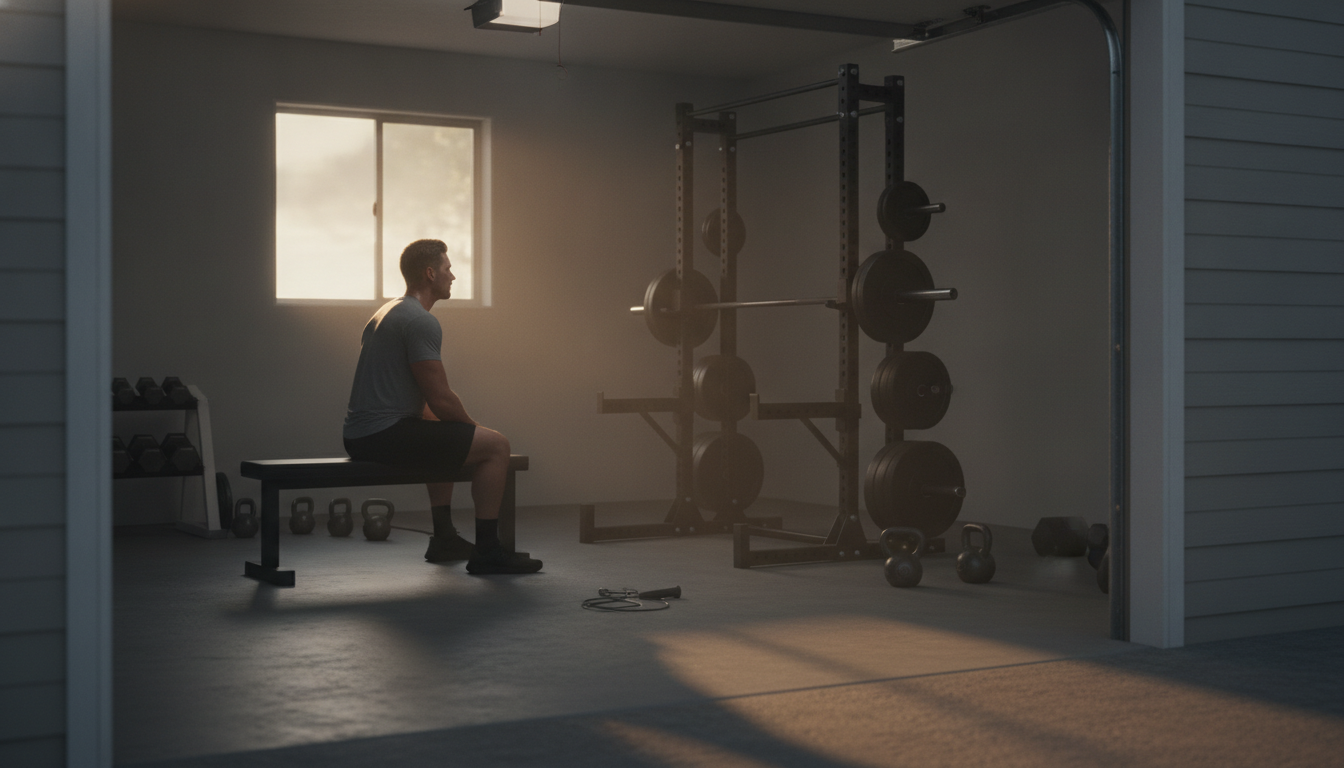
You have a rack, some plates and a rower in the garage, and the last thing on the list is a clock. The wall-mounted ones look right and cost somewhere between £150 and £600 depending on how big the digits are. The phone in your pocket does the same countdown for nothing.
The honest answer is that the hardware wins on exactly three things, and if none of them describe your training, you are buying a very expensive display for a job software already finished. Here is how to tell which side you are on.
What you are actually paying for is the digits
A wall timer's whole product is a number readable from thirty feet away at an angle, while you are upside down under a barbell or ninety seconds into a rower with your eyes watering. Four-inch LED digits do that. A phone propped against a water bottle does not, and a watch face requires you to stop and rotate your wrist.
That is not a small thing if your working position moves. Doing burpees, wall balls, rope climbs or anything on the floor means the clock is behind you, above you, or in the wrong plane half the time. Glancing at a wall is free; hunting for a phone on the floor costs you a rep.
If you train mostly in one spot — a mat, a bench, a treadmill, a bike — the visibility argument evaporates. The device sits at eye level two feet away and you can read it perfectly.
The three cases where hardware genuinely wins
More than one person is looking at it. The moment you train with a partner or run a small class, a shared clock stops being a convenience and becomes the only sane option. Two people cannot both watch one phone, and syncing two apps by hand is worse than useless.
Your hands are unusable. Chalk, grip tape, sweat, gloves, kettlebell callouses. Capacitive touchscreens are bad at all of these, and the moment you need to unlock, find the app and hit start between rounds, you have added ten seconds to every transition. A wall timer with a physical remote does not care what is on your hands.
Your phone genuinely should not be in the room. Some people train better with the phone in the house. That is a real preference and hardware is the only way to honour it — though an Apple Watch running standalone answers the same objection for a fraction of the money, which is worth checking before you spend.
Notice what is not on that list: accuracy. Both are quartz-accurate over a twenty-minute session. Anyone selling you precision is selling you nothing.
Where the app wins, and it is not close
Structure. Most wall timers do a handful of built-in modes — a countdown, a count-up, Tabata, an interval, maybe an EMOM — and configuring anything past that means a button-and-blinking-digit ritual you re-learn every time. A ladder of 60/45/30/20 with a two-minute break between blocks is either impossible or a five-minute setup job. In an app it is a saved workout you tap once.
Memory. The session you built last Tuesday is still there next Tuesday. Hardware timers overwhelmingly forget everything when you power-cycle them, so a workout with any shape gets rebuilt from scratch or written on a whiteboard beside the clock.
Cues you can hear. A wall timer beeps identically at every transition. A phone can tell you what changes — a different tone for work than rest, a spoken exercise name, a three-second count into the next round — which matters most in exactly the situation the hardware is meant to solve: when you are not looking at it. Peak Interval gives each phase its own audio and haptic cue, plus a prep phase before the first rep, so the boundary announces itself and you never need the screen at all.
Cost and portability. The app is a fraction of the price and comes to the hotel gym, the park and the track. The wall timer stays on the wall.
The rule that settles it
Buy the wall timer if you coach, train with other people, or work in positions where you physically cannot see a small screen — and treat it as a display, not a training system. It is genuinely good at being big and legible and nothing else.
Skip it if you train alone, mostly in one spot, and your sessions have any structure worth saving. A phone or watch running a proper interval app covers that case completely, and the several hundred pounds is better spent on a second kettlebell.
The middle path is the one most solo garage lifters land on and rarely name out loud: run the workout on your wrist, where the structure and the cues live, and let audio do the work the big digits were supposed to do. If you can hear the round change, you never needed to see it.
Before you spend £400 on a clock
Peak Interval runs nested sets, per-phase audio cues and saved workouts from your wrist — no phone on the floor, no rebuilding the session every week.
Download Peak Interval