Elliptical HIIT Workout: Real Intervals On A Low-Impact Machine
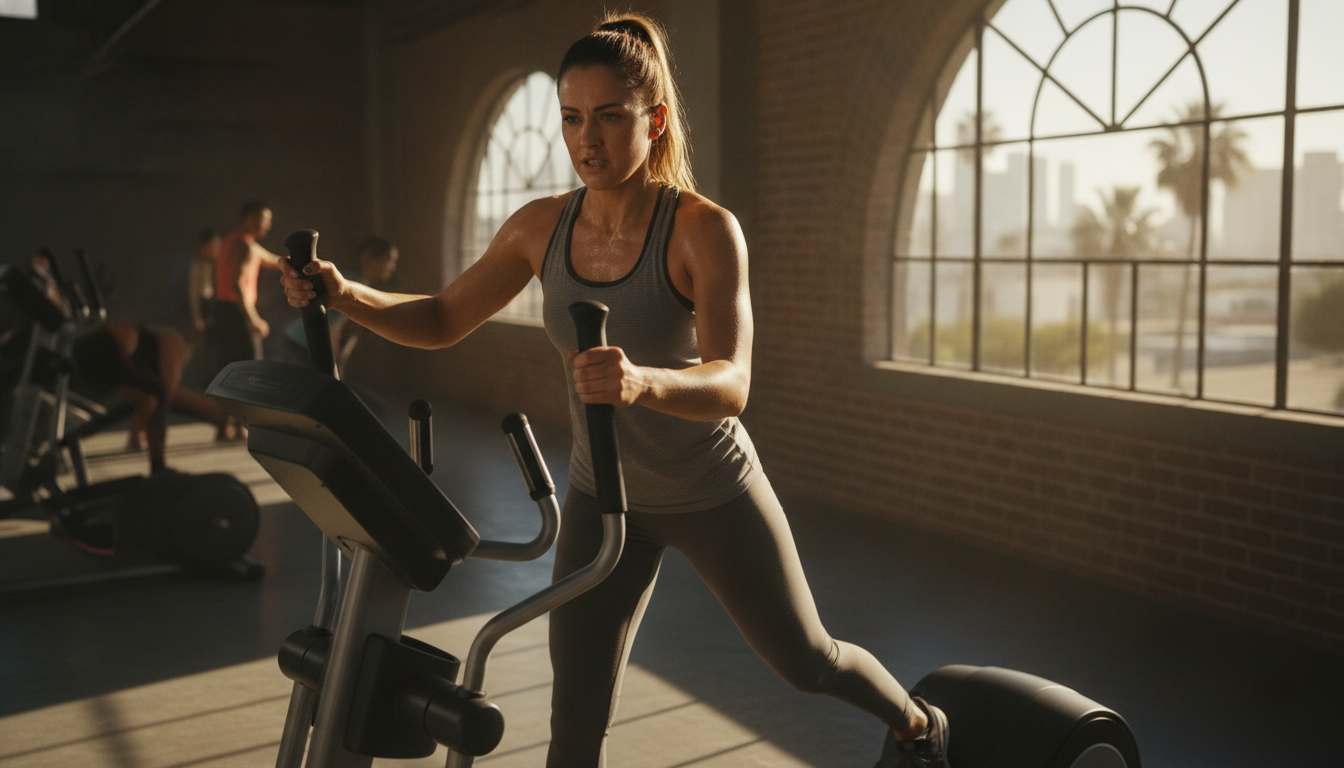
You picked the elliptical because treadmill sprints make your knees or shins complain. You press "Intervals" on the console and get a program that nudges the resistance up two levels for a minute, then back down, over and over. Twenty minutes later you are sweaty but not tired, and you wonder whether elliptical HIIT is even a thing.
It is, but the machine will not do it for you. The elliptical is smooth and forgiving, which is exactly why a lazy interval feels like work while barely moving your heart rate. Real intervals on it need a deliberate effort lever, work blocks sized to how slowly the machine loads you, and a timer that runs your plan instead of the console's.
Why elliptical intervals feel too easy
On an elliptical, momentum does part of the work. The flywheel keeps the pedals moving, so once you are rolling you can coast through a "hard" block at almost the same effort as the easy one. Bumping resistance by two levels does not change that much; your legs simply slow down a little and the effort stays flat.
The fix is to decide what "hard" means before you start and make the change big enough to feel. A useful test: during a work block you should not be able to say more than a few words, and by the last 10 seconds you should be counting down. If you could hold a conversation, the interval is not doing anything.
Pick one effort lever per session
You have four ways to make an elliptical harder, and they work best one at a time:
- Stride rate. Keep moderate resistance and lift your pace from about 130 to 160+ strides per minute. Best for shorter, sharper blocks.
- Resistance. Add four to six levels, not two, and hold your stride rate as close to steady as you can. Best for longer, grinding blocks.
- Incline or ramp, if your machine has one. Raising it shifts the work toward glutes and hamstrings and feels more like climbing.
- Arms. Drive the handles hard instead of resting on them. This is the lever most people ignore, and it can add a lot of effort with no extra impact.
Write down the numbers you use, such as "level 12 at 155 spm." That turns a vague "hard" into something you can beat next week. Reverse stride is a good way to change things up between sessions, but do not switch to it in the middle of a block; the change of direction costs you several seconds.
Work blocks run longer than on a bike
On a bike you can hit full effort in two pedal strokes, so 10 to 20-second sprints work. The elliptical responds more slowly: it takes 10 to 15 seconds for higher resistance or a faster pace to actually show up in your breathing. A 20-second block ends just as it starts to count.
So size the work at 30 to 60 seconds. Forty seconds hard and 80 seconds easy is a good place to start. Once that feels controlled, move to 45/60, then 60/60. Tabata's 20/10 format can be done on an elliptical, but it is the weakest machine for it; use a bike or a rower if 20/10 is what you want.
Recovery should be a real easy pace, not a stop. Keep the pedals turning at low resistance so the flywheel is already moving when the next block starts.
A 28-minute elliptical HIIT session
This works on any gym or home elliptical, with or without incline:
- Five minutes easy, with the last minute at a slightly faster stride rate.
- Ten seconds of prep to set the resistance for the first block.
- Eight rounds of 45 seconds hard (resistance up four to six levels, arms driving) and 75 seconds easy at low resistance.
- Two minutes easy, then a finisher of four rounds of 30 seconds at your fastest stride rate with 30 seconds easy.
- Four minutes cooldown.
In week one, do five main rounds instead of eight. Once eight rounds feel repeatable, cut recovery to 60 seconds before making the work blocks longer.
Run it off a timer you can hear
Halfway through a hard block you are looking straight ahead, and the console may be showing calories instead of time. A spoken cue a few seconds before each change lets you drop the resistance on time instead of late, and a round count spoken out loud ("round five of eight") keeps you from losing track.
In Peak Interval you set this up once: a prep phase to set the resistance, work and recovery blocks, the main set plus a separate finisher block, and spoken cues on every change. Save it, and next time you start it with one tap. If the gym is loud or you are listening to music, an Apple Watch gives you a wrist tap at each change, and you can start the workout from your wrist without letting go of the handles.
Make the elliptical work for you
Elliptical HIIT works once you stop letting the machine choose the intervals. Pick one lever and make the change large, keep work blocks long enough for the effort to register, keep the legs moving during recovery, and let a timer handle the counting.
You keep the low impact that made you choose the machine, and you get a session that actually tires you out. Progress is easy to track: more rounds, shorter recovery, or a higher resistance number for the same stride rate.
Bring your own intervals to the elliptical
Peak Interval lets you build work and recovery blocks with a prep phase and spoken cues, then run them from your iPhone or Apple Watch on any machine.
Download Peak Interval