Stationary Bike HIIT Workout: Run Your Own Intervals, Not The Console's
You got on the bike wanting 30 seconds hard and 90 seconds easy, ten times. The console offers "Hills", "Intervals" and "Fat Burn", each with its own idea of how long the hard part lasts and how much resistance it adds. None of them is the workout you had in mind, and changing them means another round of button presses with your legs already warm.
So you ride a preset that is close enough, or you count in your head off the wall clock. By the fifth sprint you are not sure whether it was the fifth or the sixth, and the recovery has quietly stretched to two minutes because nothing told you to go.
Pick one effort lever: resistance or cadence
On a bike, "hard" can mean two different things. You can add resistance and keep your legs turning at about the same speed, or you can keep resistance moderate and spin much faster. Both raise your heart rate, but they feel different and they fail differently, so pick one per session instead of changing both at once and guessing.
Resistance-led intervals are the default for short sprints. Add enough load that 100 to 110 rpm is a fight, then drop back to light resistance at 80 to 90 rpm for recovery. Cadence-led intervals suit longer blocks: keep the resistance at a moderate setting and lift your cadence from about 85 to 105 for the work, which is easier on the knees and easier to repeat.
Whichever you choose, write the number down. "Resistance 14 at 100 rpm" is something you can beat next week. "Went hard" is not.
Bike intervals can be shorter than anything else
The bike's big advantage is that effort changes almost instantly. On a treadmill the belt takes several seconds to speed up, and on a rower you need a couple of strokes to build power. On a bike you can be at full output within two pedal strokes, so work blocks as short as 10 to 20 seconds actually deliver what they promise.
That opens up formats that are awkward elsewhere. Tabata, 20 seconds on and 10 off for eight rounds, is at its most honest on a bike. So are 10-second all-out sprints with 50 seconds easy, or 30/30s where the effort stays high because the transition costs you nothing.
The trade-off is recovery. Short, hard bike sprints need longer rest than you think: start at a 1:3 work-to-rest ratio for anything all-out, and only tighten it once your last sprint is as fast as your first.
Seated or standing for the sprints
Standing lets you use your body weight and produces more power in the first few seconds, which is why it suits 10 to 20-second efforts at high resistance. Seated sprints are steadier and easier to sustain past 30 seconds, and they keep the effort in your legs rather than in your arms gripping the bars.
A simple rule: stand for the short heavy blocks, sit for anything longer than 30 seconds. If you are on a spin bike, add a quarter-turn of resistance before you stand up so the pedals do not run away from you.
A 25-minute stationary bike HIIT session
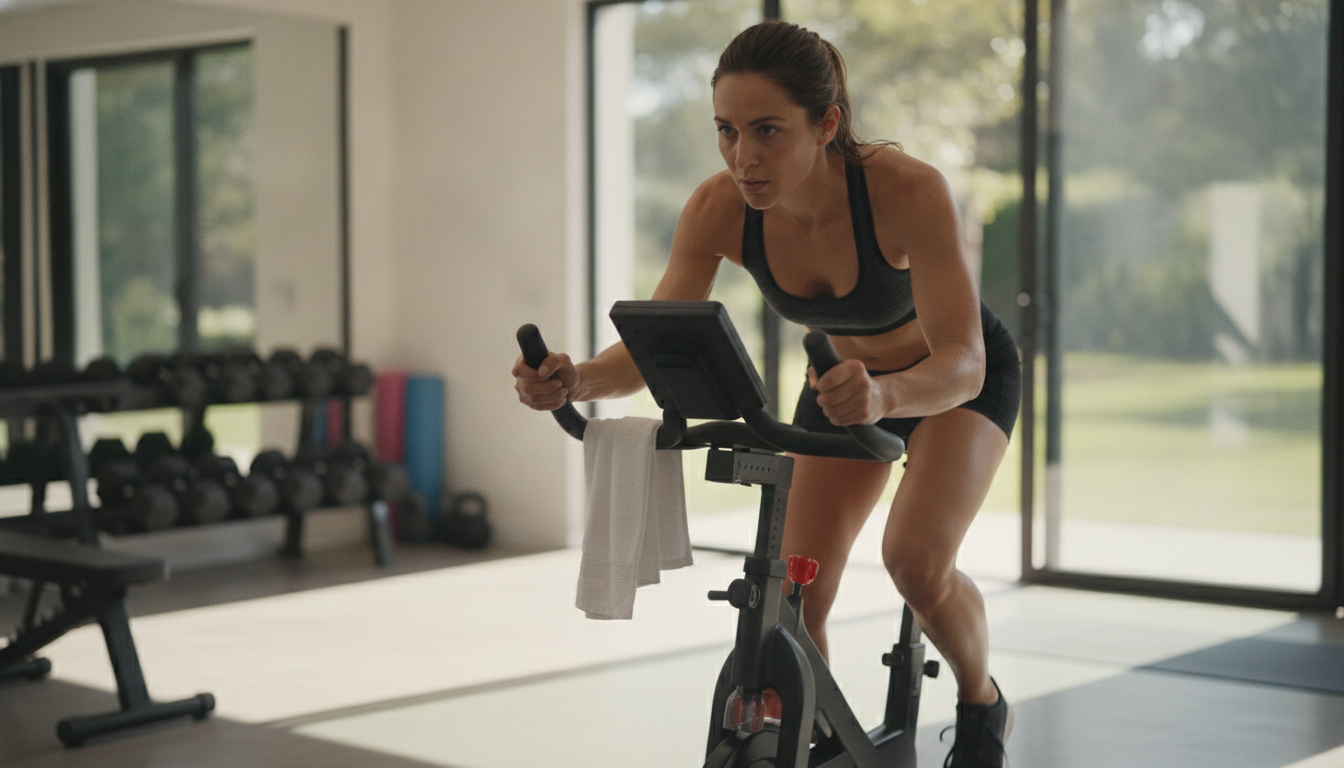
This works on a spin bike, an upright exercise bike, a Peloton or the recumbent at the hotel gym:
- Five minutes easy at 85 rpm, with two 10-second pickups in the last minute.
- Ten seconds of prep to set the resistance for the first sprint.
- Ten rounds of 30 seconds hard (resistance up, 100+ rpm, standing for the first 15) and 90 seconds easy spinning at light resistance.
- Five minutes of cooldown at light resistance.
In week one, do six rounds instead of ten. Once ten feel controlled, cut the recovery to 60 seconds before you make the sprints longer. For a change of pace, swap the middle for a Tabata block followed by five minutes easy.
Hear the change with your head down
Halfway through a sprint you are looking at the floor or the front wheel, not at the console. A spoken "easy" a couple of seconds before the work ends lets you drop the resistance on time, and a round count read out loud, "round six of ten", stops you losing your place.
In Peak Interval you build this once: a prep phase for getting clipped in and setting resistance, your work and recovery blocks, the round count, and spoken cues on every change. Save it, and next time it is a single tap. If the bike is noisy or your headphones are in, an Apple Watch gives a wrist tap at each change, and you can start the workout from your wrist without leaving the saddle.
One lever, one timer
Bike HIIT goes wrong when every variable changes at once. Choose resistance or cadence as the thing you push, size the work blocks to suit the bike's instant response, give short sprints enough recovery, and let a timer you can hear do the counting.
Then the console is just a cadence and resistance display, and progress is easy to see: more rounds, shorter rest, or a higher number on the resistance dial.
Bring your own intervals to the bike
Peak Interval lets you build work and recovery blocks with a prep phase and spoken cues, then run them from your iPhone or Apple Watch on any bike.
Download Peak Interval