Tabata Equipment Guide: What You Actually Need For 20/10 At Home
You want to start Tabata at home, and every search result is trying to sell you a rack of something. It is a four-minute format with ten seconds of rest between efforts, so a garage full of kit would mostly sit there watching you.
The honest shopping list has one essential item, which you probably already own, plus two cheap ones and one optional weight. The 10-second rest decides most of it, because anything you have to adjust, load or walk to will eat your recovery.
The one thing you can't skip: a timer that runs itself
Tabata is 20 seconds on and 10 off, eight times, and a phone's clock app can't run that without you resetting it between rounds. You won't have time to do that, and you'd lose the count if you tried. So the only real requirement is software, and it costs far less than any weight.
Check four things. It has to loop 20/10 for eight rounds with no taps, show or say which round you're on, give you a prep phase so round one doesn't start while you're walking to the mat, and sound different at work and at rest. If you want to compare specific apps, our Tabata timer roundup goes through them, and this walkthrough covers the setup.
Peak Interval has a Tabata preset that handles all four, and it runs from an Apple Watch too. That helps at home more than you'd expect: if someone is asleep down the hall, a tap on the wrist replaces a phone beeping across the room.
Floor, mat and shoes
You need about two square metres of clear floor, roughly the footprint of a yoga mat plus an arm's length on each side. Burpees, squats, mountain climbers and high knees all fit inside that. Look up before you start, because a jump with a low light fitting overhead is a short workout.
A mat earns its place for anything with your hands or knees down, and 5 to 6 mm with a grippy surface is plenty. Thicker foam feels comfortable on sit-ups but gets unstable when you land on it, and that matters most in round seven, when your feet are getting sloppy. If you live above someone, a couple of interlocking rubber tiles under the jumping area help more than a thicker mat does.
Wear flat, stable trainers for anything with jumps. Bare feet are fine for floor work, but on hard floors you'll feel eight rounds of landings in your shins. Keep a towel within reach as well, since a sweaty mat gets slippery by about round five.
The one implement worth buying, if any
Bodyweight is enough to make Tabata hard. At full effort, eight rounds of squat jumps will leave you on the floor without any equipment at all, so buy a weight because you want variety and not because the format demands it.
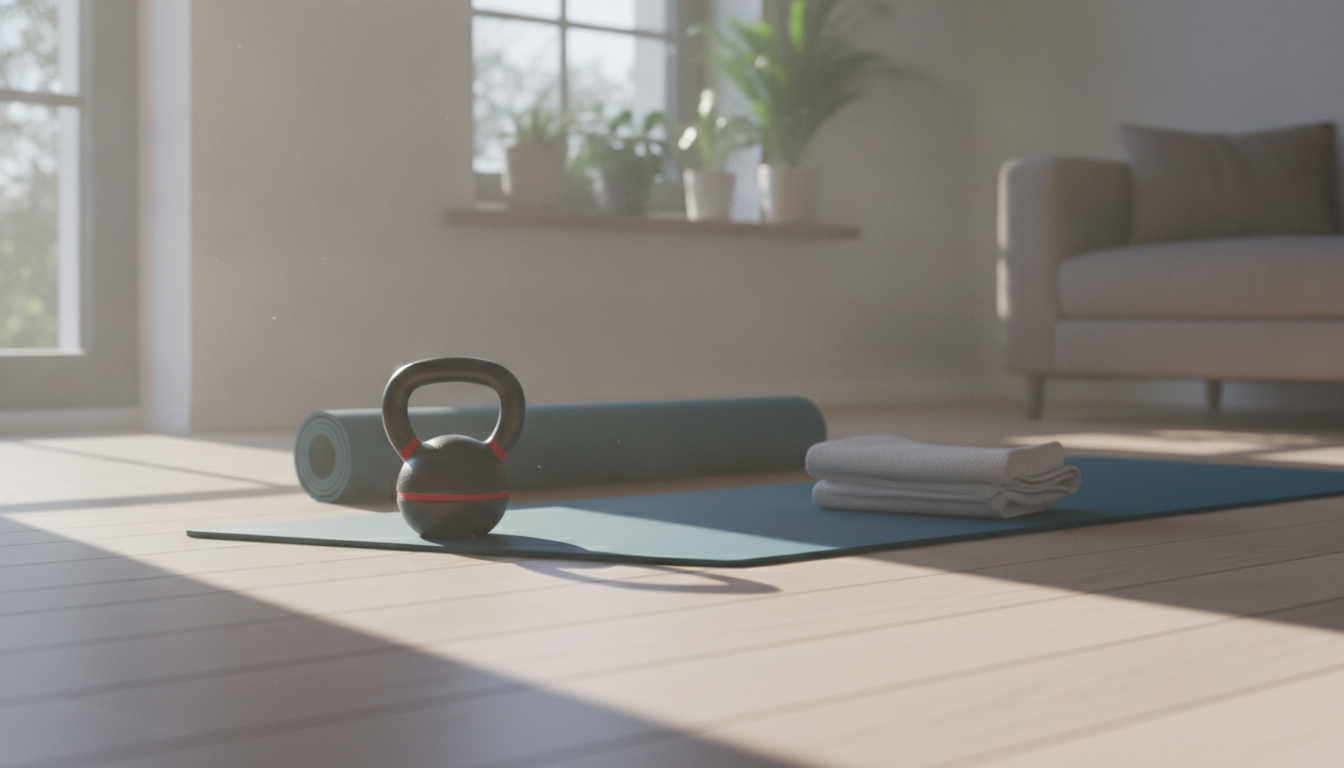
If you buy one thing, make it a single kettlebell. It handles swings, goblet squats and thrusters without any setup, and it sits on the floor between rounds, ready to pick up. Most people will land somewhere between 8 and 16 kg (about 18 to 35 lb). To test the weight, you want roughly 12 to 15 clean swings in the first 20 seconds, with your hips still driving the bell in round eight. If your back starts doing the work, go lighter.
A fixed pair of light dumbbells is a fair alternative if you prefer thrusters and snatches. A jump rope is cheap and brutal, but it needs more room and a higher ceiling than the mat, and a trip costs you part of a 20-second round. If you already own a bike or rower, use it: the original 1996 protocol ran on a cycle ergometer. Just set the resistance before you start, because 10 seconds isn't enough to change it safely.
What to leave in the basket
Skip anything that needs changing between rounds. Adjustable dumbbells, plate-loaded bars and door-anchored bands all look versatile, but you won't get to use that versatility in a 10-second rest. Pick one setup for the whole block and leave it there.
Weighted vests work against the format, too. Tabata rewards fast, clean reps, and a vest slows them down while making landings harder on your knees just as you're getting tired. Plyo boxes have a similar problem: a missed box jump is a bad way to end round seven.
You can also pass on a chest-strap heart rate monitor for this. Heart rate lags behind effort, so across 20-second bursts it tells you little you can act on mid-set. Your rep count per round is a better read on how hard you're working, and it's free.
The short version
Start with a timer that runs 20/10 for eight rounds on its own, two square metres of floor, a 5 to 6 mm mat, flat shoes and a towel. Run bodyweight for a few weeks, and if you still want more, buy one kettlebell you can swing for all eight rounds. Once you have the kit, our Tabata guide has five workouts to run with it.
The one piece of Tabata kit you can't skip
Peak Interval's Tabata preset runs prep, all eight rounds and distinct work and rest cues on iPhone and Apple Watch, so you never touch the screen mid-set.
Download Peak Interval